Space Weather Lab
Education-first dashboards for amateur radio operators (UTC)
Now
Planetary Kp (1-minute)
3.33
as of 2026-03-21T06:58:00
What does this mean to me?
Kp is a quick “storminess” indicator. Higher Kp often means more fading/flutter and poorer polar paths on HF.
If Kp rises, try non-polar routes and lower bands, and expect aurora potential on VHF.
F10.7 cm Solar Flux
102
as of 2026-03-20T22:00:00
What does this mean to me?
F10.7 is a baseline “how supportive is the ionosphere?” indicator. Higher values usually favor higher HF bands (15m/10m) more often.
It’s not a guarantee—storms and local time still dominate the day-to-day outcome.
NOAA Scales
R0 / S0 / G0
Radio blackouts / Radiation storms / Geomagnetic storms
What does this mean to me?
R events can cause sudden HF absorption on the sunlit side (bands “go dead”).
G events often degrade HF (especially polar) but can enable aurora on 2m/70cm.
Cache generated
2026-03-21T07:01:53+00:00
Auto-refresh every 60 seconds
Space Weather Overview
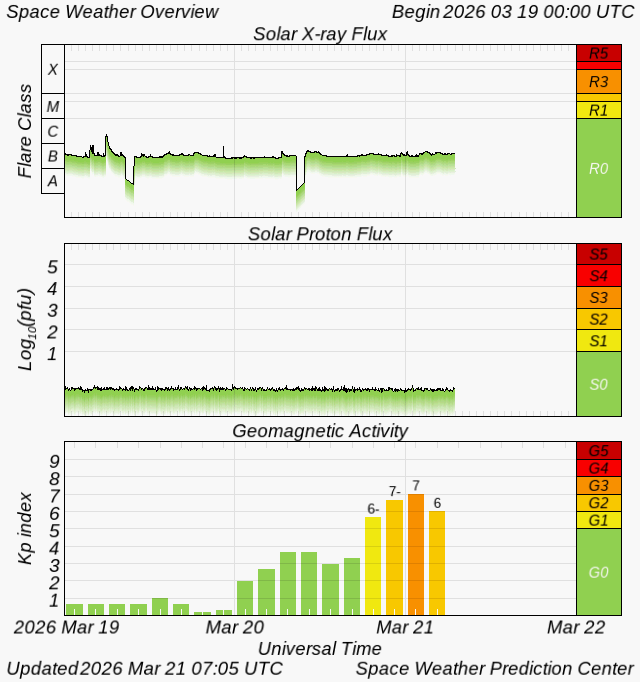
Live Plots (NOAA/SWPC)
These images are pulled directly from SWPC’s public image products and are useful for quick visual context.
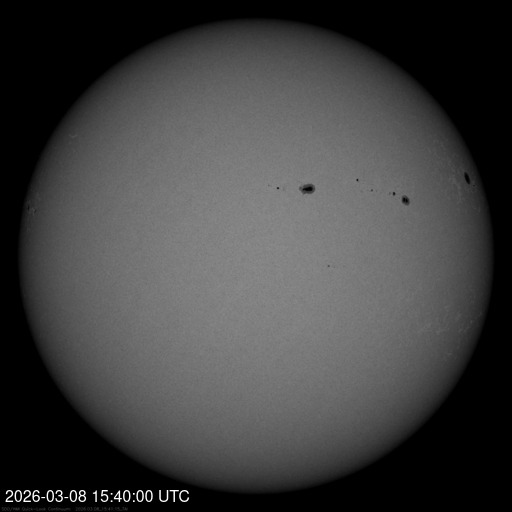
Solar Disk (Sunspots — white light)
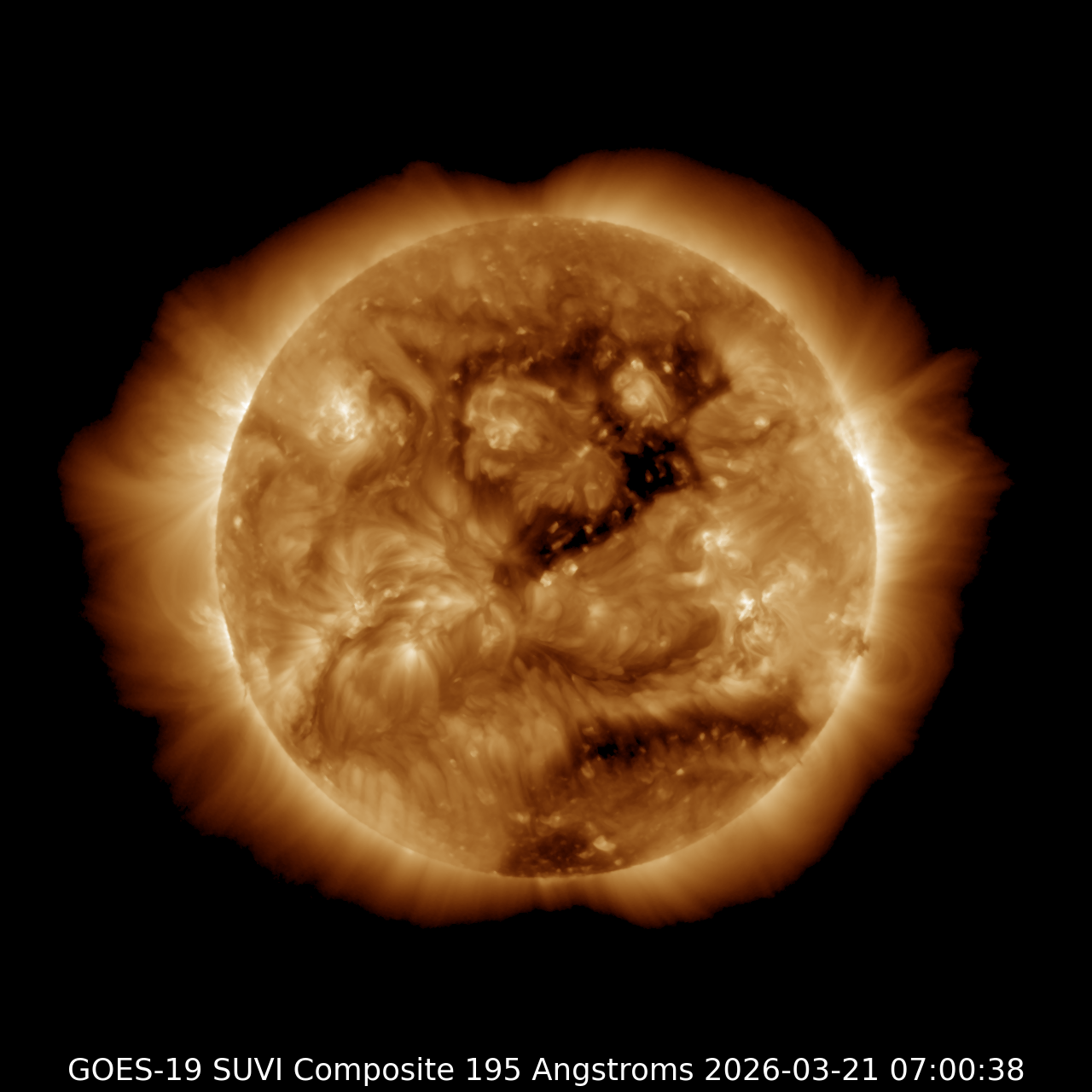
Solar Disk (Active regions — color EUV 195Å)
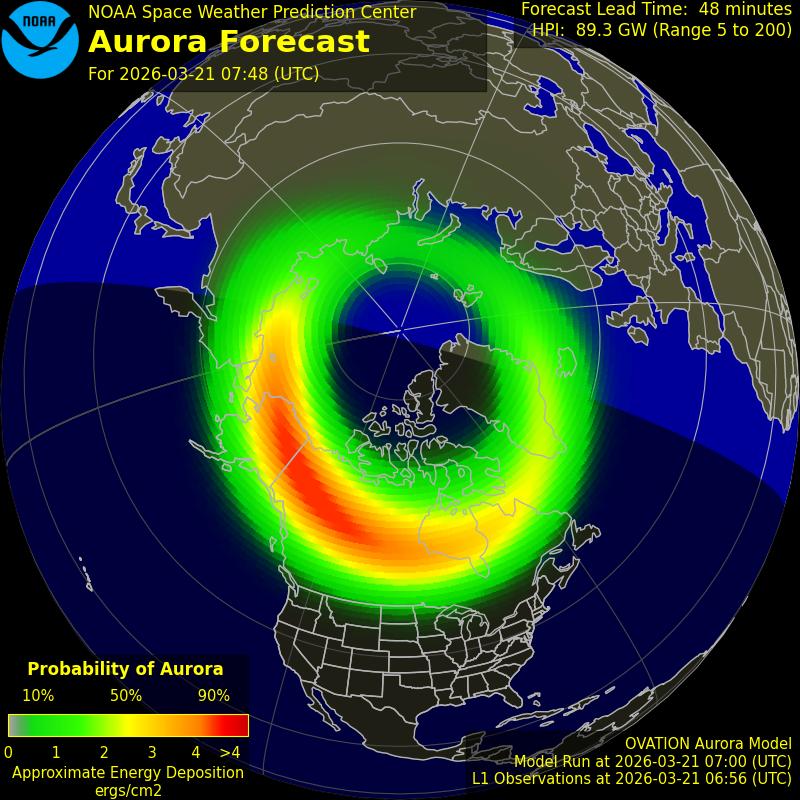
Aurora Forecast (Northern Hemisphere)
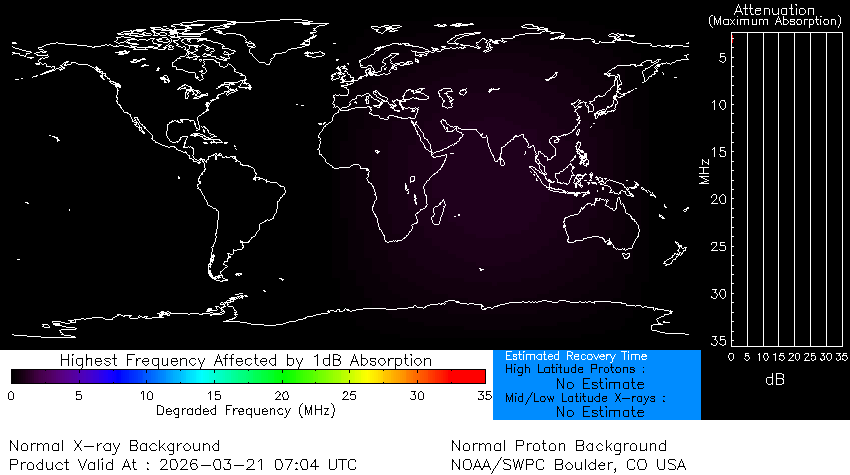
D‑RAP (HF Absorption / D‑Layer)
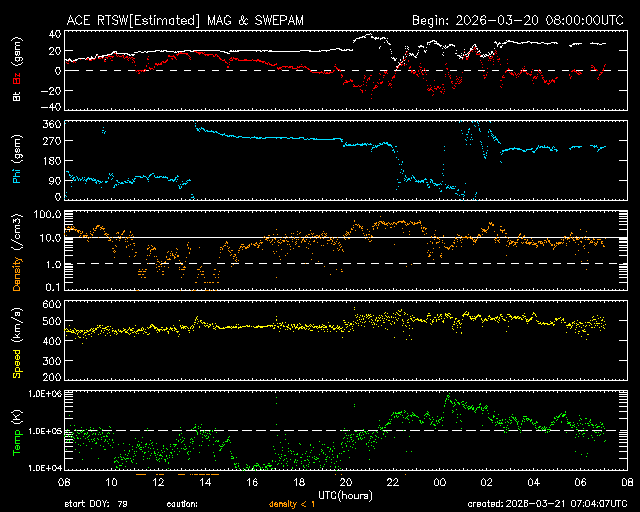
Real-Time Solar Wind (ACE MAG + SWEPAM)
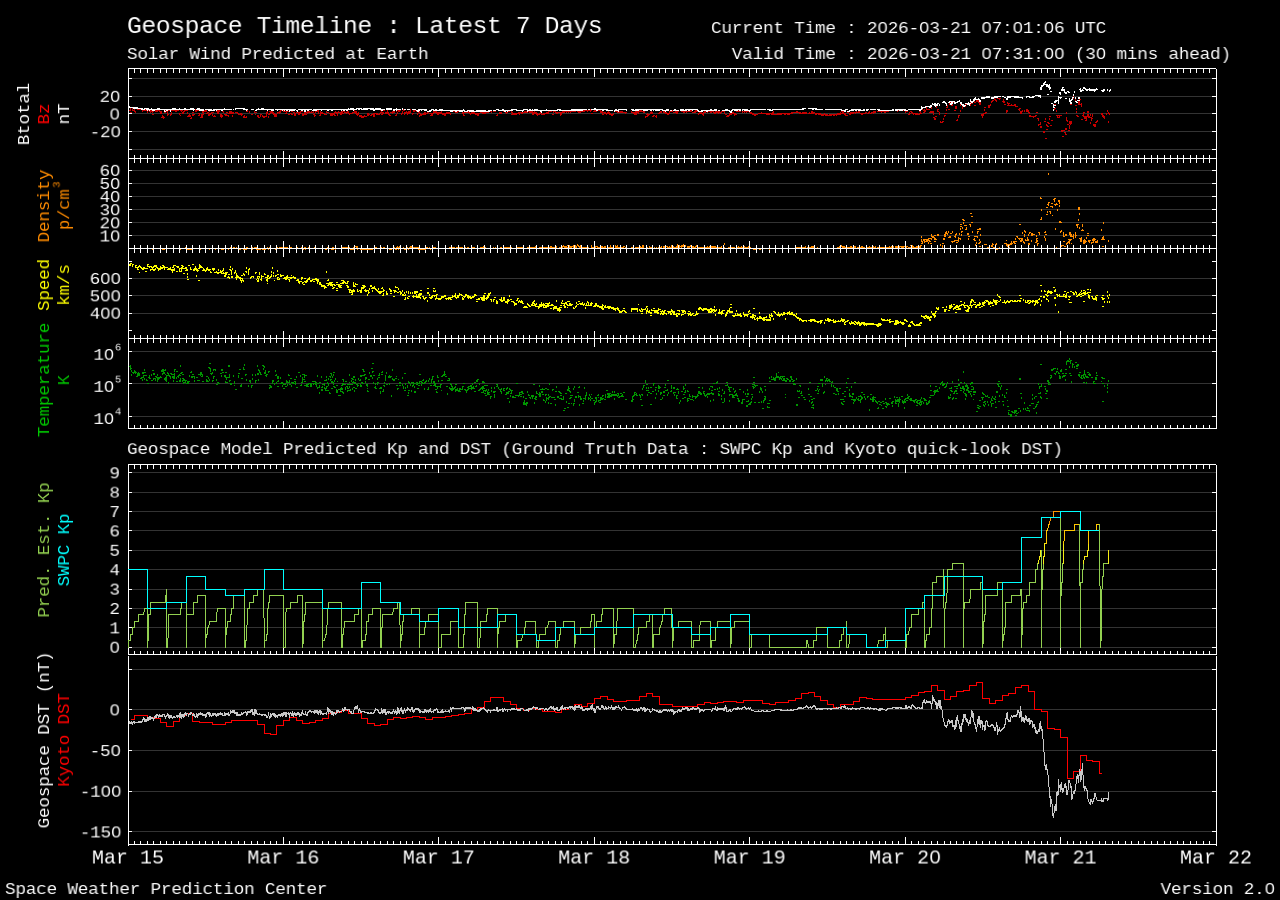
Geospace (7‑Day)
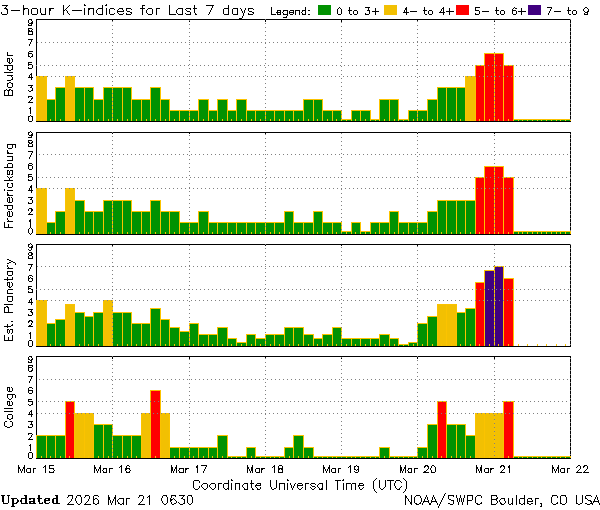
Station K Index
Alerts / Watches / Warnings Timeline
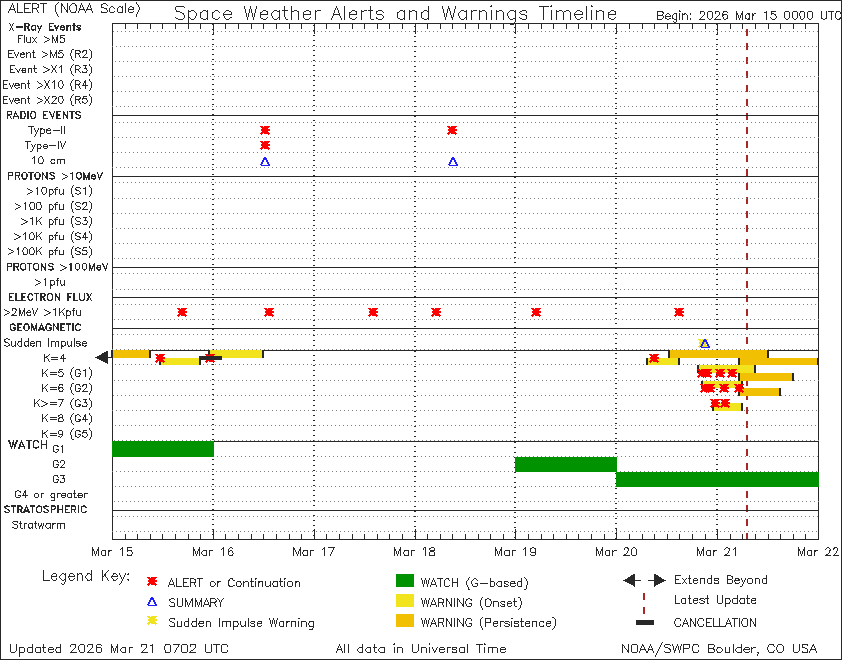
What does this mean to me? (Next 3 days)
Next 3 days (plain-English band outlook):
- Storminess: Kp ≈ 6.7 (stormy). Higher Kp usually degrades polar HF and adds flutter.
- Solar “baseline”: F10.7 ≈ 102.0 (low). Higher tends to help 15m/10m.
- Dayside HF blackout risk (R1–R2): about 10% / 10% / 10% per day (if a flare hits, bands can drop suddenly on the sunlit side).

HF:
- 160m: mostly night-only for distance; daytime often poor due to absorption + noise.
- 80m: best after local sunset through pre-dawn; daytime often limited by D-layer absorption.
- 60m: good for regional/nighttime; usually more stable than 80m in noisier environments.
- 40m: reliable day/night bridge band; expect best DX around grayline and at night.
- 30m: often steady DX when 20m is crowded/unstable; less sensitive to MUF swings.
- 20m: primary DX workhorse; if Kp is unsettled/stormy, avoid polar routes first.
- 17m: similar to 20m but more “selective”; benefits from higher F10.7.
- 15m: spotty; check midday/grayline.
- 12m: often intermittent; worth checking midday.
- 10m: often closed or short-skip; still check around local noon.

VHF/UHF & satellites:
- 6m: mostly line-of-sight unless there is Es/TEP; space weather matters less than seasonal Es.
- 2m/70cm: normally line-of-sight; if Kp is high, aurora can enable unique paths but may distort signals.
- Satellites: stormy days can increase fades/scintillation (especially on higher frequencies and some geometries).
Show official SWPC 3‑day forecast text
:Product: 3-Day Forecast
:Issued: 2026 Mar 21 0030 UTC
# Prepared by the U.S. Dept. of Commerce, NOAA, Space Weather Prediction Center
#
A. NOAA Geomagnetic Activity Observation and Forecast

The greatest observed 3 hr Kp over the past 24 hours was 7 (NOAA Scale
G3).
The greatest expected 3 hr Kp for Mar 21-Mar 23 2026 is 6.67 (NOAA Scale
G3).

NOAA Kp index breakdown Mar 21-Mar 23 2026

             Mar 21       Mar 22       Mar 23
00-03UT       6.67 (G3)    4.67 (G1)    3.33
03-06UT       6.33 (G2)    5.00 (G1)    4.33
06-09UT       5.67 (G2)    4.33         3.00
09-12UT       5.00 (G1)    4.00         3.00
12-15UT       3.33         2.67         2.00
15-18UT       4.00         3.33         2.00
18-21UT       4.67 (G1)    4.33         3.33
21-00UT       4.33         4.33         3.00

Rationale: G1-G3 (Minor-Strong) geomagnetic storm conditions are
expected on 21 Mar with G1 (Minor) conditions likely on 22 Mar due to
persistent CME effects followed by HSS activity.

B. NOAA Solar Radiation Activity Observation and Forecast

Solar radiation, as observed by NOAA GOES-18 over the past 24 hours, was
below S-scale storm level thresholds.

Solar Radiation Storm Forecast for Mar 21-Mar 23 2026

              Mar 21  Mar 22  Mar 23
S1 or greater    1%      1%      1%

Rationale: No S1 (Minor) or greater solar radiation storms are expected.
No significant active region activity favorable for radiation storm
production is forecast.

C. NOAA Radio Blackout Activity and Forecast

No radio blackouts were observed over the past 24 hours.

Radio Blackout Forecast for Mar 21-Mar 23 2026

              Mar 21        Mar 22        Mar 23
R1-R2           10%           10%           10%
R3 or greater    1%            1%            1%

Rationale: No R1 (Minor) or greater radio blackouts are expected.  No
significant active region flare activity is forecast.
What does this mean to me? (Next 7–10 days)
Next 7–10 days (SWPC 27-day outlook, simplified):
- Day-by-day (UTC): unavailable (SWPC 27-day outlook table not fetched; check Status page / cache warmer).
- These are probabilistic outlooks. Confirm with a quick on-air scan (FT8/WSPR/beacons).
Show official SWPC 27‑day outlook table
:Product: 27-day Space Weather Outlook Table 27DO.txt
:Issued: 2026 Mar 16 0302 UTC
# Prepared by the US Dept. of Commerce, NOAA, Space Weather Prediction Center
# Product description and SWPC contact on the Web
# https://www.swpc.noaa.gov/content/subscription-services
#
#      27-day Space Weather Outlook Table
#                Issued 2026-03-16
#
#   UTC      Radio Flux   Planetary   Largest
#  Date       10.7 cm      A Index    Kp Index
2026 Mar 16     108          15          4
2026 Mar 17     108          10          3
2026 Mar 18     105           8          3
2026 Mar 19     105           5          2
2026 Mar 20     105          10          3
2026 Mar 21     100          35          5
2026 Mar 22     102          25          5
2026 Mar 23     105          15          4
2026 Mar 24     110          15          4
2026 Mar 25     100          18          5
2026 Mar 26     110          10          3
2026 Mar 27     120           8          3
2026 Mar 28     125           5          2
2026 Mar 29     125           5          2
2026 Mar 30     125          15          4
2026 Mar 31     125          10          3
2026 Apr 01     130           5          2
2026 Apr 02     135           5          2
2026 Apr 03     140          18          5
2026 Apr 04     135          20          5
2026 Apr 05     135           8          3
2026 Apr 06     130          15          4
2026 Apr 07     135           8          3
2026 Apr 08     130           5          2
2026 Apr 09     125          25          5
2026 Apr 10     120          40          6
2026 Apr 11     115          20          5
WWV Space Weather Text
:Product: Geophysical Alert Message wwv.txt
:Issued: 2026 Mar 21 0605 UTC
# Prepared by the US Dept. of Commerce, NOAA, Space Weather Prediction Center
#
#          Geophysical Alert Message
#
Solar-terrestrial indices for 20 March follow.
Solar flux 102 and estimated planetary A-index 34.
The estimated planetary K-index at 0600 UTC on 21 March was 6.00.

Space weather for the past 24 hours has been strong.
Geomagnetic storms reaching the G3 level occurred.

Space weather for the next 24 hours is predicted to be moderate.
Geomagnetic storms reaching the G2 level are expected.
What does this mean to me?
WWV text is a compact, operator-friendly summary. When it mentions flares, CMEs, or storming, expect rapid changes: verify with an on-air scan.
Band Guidance (heuristic)
This is a lightweight, operator-focused heuristic based on Kp and F10.7. It is not a prediction—validate with on-air checks.
| Band group | Rating | Why |
|---|---|---|
| 10–12–15 m | poor | Low solar flux and/or elevated geomagnetic activity. |
| 17–20 m | good | Mid bands often remain workable unless storms are strong. |
| 30–40 m | good | Often workable; watch storm effects on longer/high-latitude paths. |
| 60–80 m | fair | Lower bands can work well at night; performance is noise/absorption-limited. |
How to use this (quick)
F10.7
Higher often supports higher MUF (better high-band HF), but it’s not the whole story.
Kp
Higher means more geomagnetic disturbance (HF absorption, polar flutter, degraded paths).
R/S/G
Operational “headline” severity levels. Great for fast situational awareness.